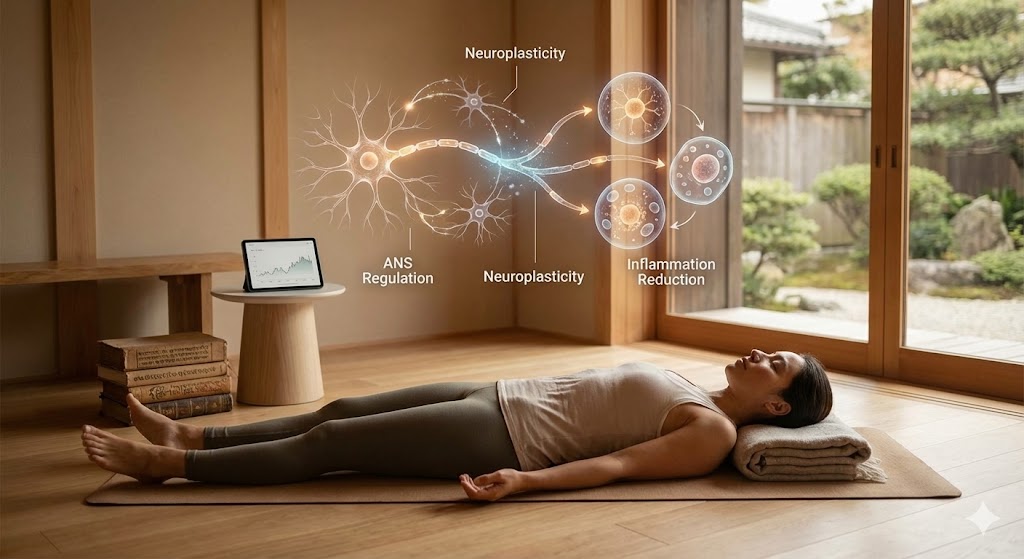
The Crisis of Activation and the Call for Conscious Rest
The architecture of modern existence—characterized by constant connectivity, information overload, and relentless professional demands—has precipitated a systemic physiological challenge: chronic sympathetic nervous system (SNS) dominance, commonly known as the fight-or-flight state. This persistent state of hyper-arousal manifests clinically as burnout, chronic fatigue syndrome, and a reduction in both mental and physical productivity. The body and mind, perpetually activated, lose the essential capacity for repair and rejuvenation, undermining long-term health and vitality.
In response to this activation crisis, the ancient yoga system offers a sophisticated and systematic methodology for restoration that transcends conventional passive relaxation. Yogic rest, or Visranti, is fundamentally different from merely “snoozing” or engaging in unstructured relaxation. It is defined as a conscious, systematic discipline designed for deep neurophysiological, cellular, and psychological repair, often requiring an intentional, sustained presence of mind. This distinction is critical: where Western relaxation typically aims simply to “feel good,” yogic rest aims for complete conscious presence during the deepest states of physiological rest, initiating profound healing for the body, mind, and spirit.
This report aims to provide an exhaustive, evidence-based analysis linking the classical yogic framework for restoration—encapsulated by practices such as Pratyahara, the Koshas, and Yoga Nidra—to quantifiable, modern mechanisms of repair, including Autonomic Nervous System (ANS) regulation, neuroplasticity, and inflammation reduction. Furthermore, the analysis provides strategic, high-impact implementation methods suitable for integration into the life of the time-constrained, busy individual seeking sustained resilience and optimal functioning.
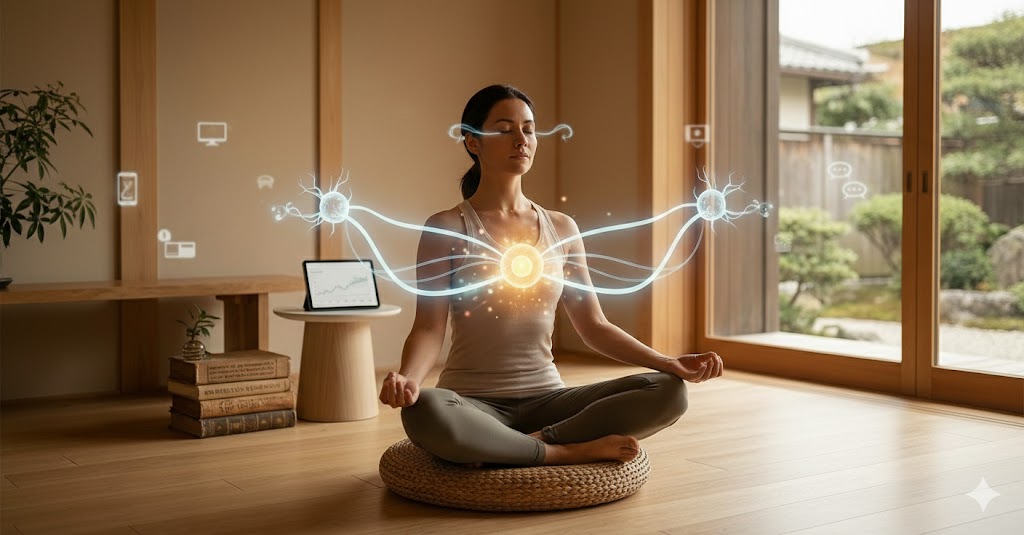
Pratyahara: The Essential Practice of Sensory Withdrawal
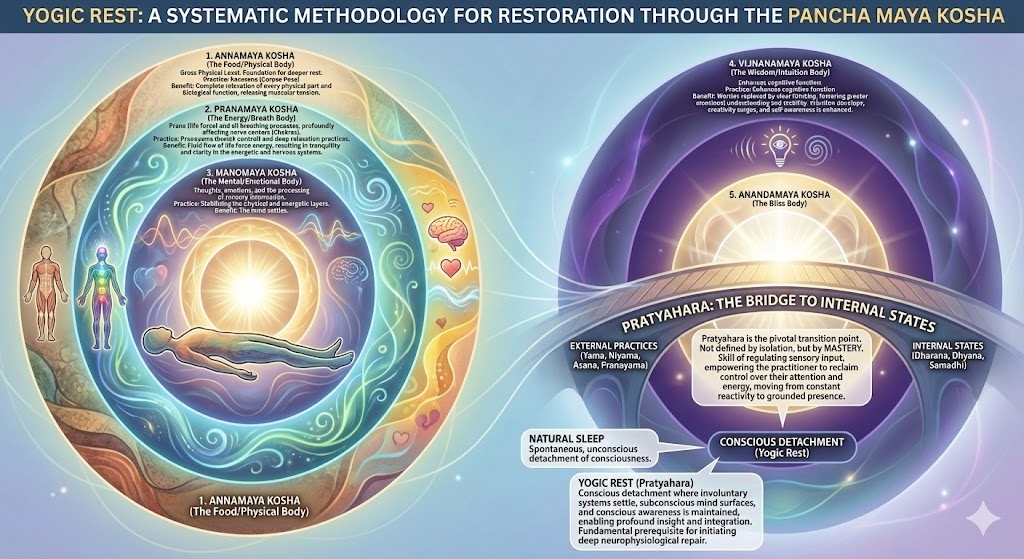
Pratyahara, the fifth of the eight limbs of Patanjali’s Ashtanga Yoga, represents the pivotal transition point, or “bridge,” between the external practices (Yama, Niyama, Asana, Pranayama) and the deep internal states of meditation (Dharana, Dhyana, Samadhi). While physical postures (asana) often dominate modern discourse, Pratyahara is one of the most transformative yet least understood aspects of the path to stillness.
The common translation of Pratyahara as “withdrawal of the senses” fails to capture its true essence, which is defined not by isolation, but by mastery. In our technology-driven world, individuals are constantly bombarded by external stimuli—glowing screens, incessant notifications, and endless chatter—which conditions the nervous system to be reactive, anxious, and unfocused. Pratyahara is the skill of regulating this sensory input, empowering the practitioner to reclaim control over their attention and energy, moving from a state of constant reactivity to one of grounded presence.
A crucial philosophical differentiation exists between genuine yogic rest and mere sleep. Natural sleep is described as a spontaneous, unconscious detachment of consciousness from sensory and motor channels. While beneficial for initial rest, it lacks conscious awareness and the ability to integrate the inner and outer worlds. True Pratyahara, as practiced in systematic relaxation techniques like Yoga Nidra, trains the involuntary systems of the brain to settle and allows the subconscious mind to surface, all while conscious awareness is maintained, enabling profound insight and integration. Therefore, the conscious detachment achieved through Pratyahara is the fundamental prerequisite for initiating deep neurophysiological repair.
The Pancha Maya Kosha Model: Mapping Layers of Rest
To facilitate this systematic detachment and repair, the yogic tradition utilizes the Pancha Maya Kosha model, which describes the human experience through five interconnected sheaths or layers of being. This model serves as both a diagnostic tool—identifying where tension or illness resides—and a prescriptive roadmap for restoration.
- Annamaya Kosha (The Food/Physical Body): Restoration begins at the gross physical level. Practices like Savasana (Corpse Pose) target this layer by requiring the complete relaxation of every physical part and biological function, releasing muscular tension and preparing the foundation for deeper rest.
- Pranamaya Kosha (The Energy/Breath Body): This sheath encompasses Prana (life force) and all breathing processes, profoundly affecting nerve centers (Chakras). Once the physical body is still, attention shifts to the breath. Working with the breath through Pranayama (breath control) and deep relaxation practices allows the flow of life force energy to become fluid, resulting in tranquility and clarity in the energetic and nervous systems.
- Manomaya Kosha (The Mental/Emotional Body): This layer is comprised of thoughts, emotions, and the processing of sensory information. By stabilizing the physical and energetic layers, the mind settles.
- Vijnanamaya Kosha (The Wisdom/Intuition Body): The calmness achieved through systematic relaxation enhances cognitive function. Settling the mind allows worries to be replaced by clear thinking, fostering greater emotional understanding and stability. As consciousness moves through the Vijnanamaya Kosha, intuition develops, creativity surges, and self-awareness is enhanced.
Prana and Nadis: The Subtle Architecture of Healing
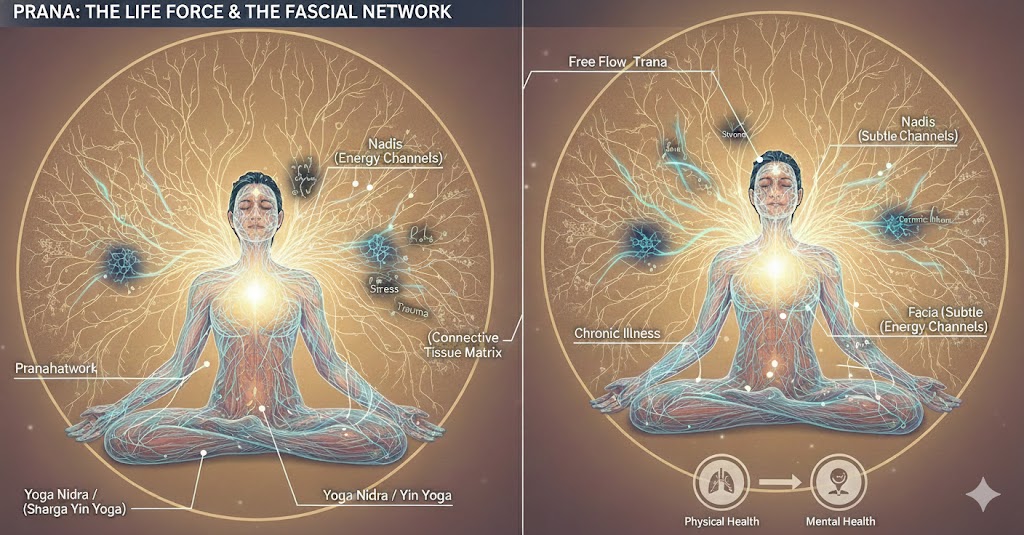
At the core of yogic healing is the concept of Prana, which is universally recognized as the foundational life force, vitality, or basic life energy that permeates all existence. Pranayama (breathwork) is understood as the methodology for controlling this vital energy, and its mastery is considered the ultimate basis of health and wellness.
Prana moves through the body via thousands of subtle energy channels known as Nadis. Stress, trauma, and chronic illness cause blockages in these channels, which disrupts the balance of psychic and vital energies. The profound relaxation achieved in practices like Yoga Nidra enables the free flow of these energies, which is the basis for achieving optimal physical and mental health.
The connection between this ancient energetic model and modern physiology lies in the body’s connective tissue. Recent biomedical research strongly suggests that the dense network of fascia within the body may serve as the physical substrate for the subtle energy channels described as meridians in Traditional Chinese Medicine (TCM) and, by extension, the Nadis in yoga. Fascia is the medium through which energetic imbalances manifest and through which they can be corrected. Because connective tissues are drier structures requiring time and specialized care, practices that target them, such as Yin Yoga, are effective means of remodeling this tissue, releasing deeply held tension in the body and mind, and restoring the smooth flow of Prana.